Sunday, January 8, 2012

When will the media ever learn? Mutually assured political destruction isn't a convincing threat.

In the January 8, 2012 New York Times, columnist and University of Chicago Professor Richard Thaler chides the US Congress and President Obama for not understanding the art of bargaining. He suggests that they read Tom Schelling's Essay on Bargaining. Therein lies the problem. The press (and media in general) have absolutely no idea of how to interpret what's going on when negotiations are unfolding, and Shelling's bargaining model, developed to explain cold war nuclear politics and the logic of Mutually Assured Destruction, won't help at all.


There are two ways to think about conflicts and conflict resolution efforts. The first assumes that there has to be a winner and a loser -- that the gains to one side must be matched by losses to the other. This is how zero-sum thinking emerged. But, there's another way to think about negotiations, whether between countries, companies, communities or other actors. This involves non-zero sum thinking, or mutual gains. This requires thinking in terms of how each side does in each negotiation relative to its realistic walk-away option (not to what the other side does or doesn't get). Both sides can come out ahead compared to their realistic walk-away options. If two bordering countries are fighting about how much water each can take from the river, then, in zero-sum terms, what one gets the other loses. But, if they can figure out how to work together so that one country can use the water for what it needs (to support provide drinking water to a growing urban population) and then send it along to the other country (assuming the appropriate technology and management systems can be installed), the other can then use almost all the same water over again for a different purpose (such as expanded agricultural production). The issue is not whether one side wins by depriving the other of the water it needs; rather, the question is whether they are smart enough to think of a way that gives both sides the water they need to meet their most important requirements.

When I look at the current political situation in Washington, I don't see any effort being made to help both "sides" meet their interests simultaneously. I'm not talking about bi-partisanship or "playing nice." I understand that politicians in both political parties are mostly interested in getting re-elected and expanding their party's control of Congress and the Executive branch. But, each side also has to meet the interests of its constituents if they want to get elected. That's why negative advertising isn't enough. Each party and each candidate also has to prove that it can and will meet the interests of its constituents.

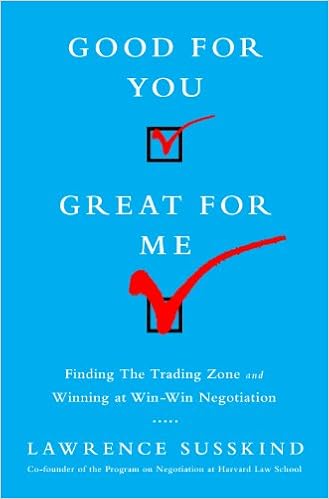
If I'm on one side of the aisle, and I can offer a way to the other side of meeting the needs of its constituents while also meeting the needs of my backers, I'm likely to have a winning proposal. That doesn't involve compromise. It's not about splitting the difference and showing that I care about the country in general. It's not about the use threats to exact concessions from the other side. I just have to be smart enough to come up with a package that is "good for them, and great for me."

Thaler urges Obama to threaten Congress with substantial "pain" in the future when the President will be in a position (at least for a short time) to block the extension of the payroll tax. He suggests trading a promise to inflict less pain in the future for concessions from the Republicans now. But, if I'm on the Republican side, that's not compelling. I'll just wait out the electoral process and take what I want when I win big majorities in the House and Senate (and win the Presidency). Or, so the Republicans think. There's no reason for them not to be optimistic. When it comes to what we want, we are all able to convince ourselves that the future will be especially good for us. We don't care about what happened in the past. We're terribly biased in our own favor when thinking about what might happen in the future.

Thaler suggests that the Republicans ought to give President Obama a chance, for at least a year, to appoint the people he wants in key posts. Otherwise, Thaler says, when the Republicans win the elections they'll have to deal with nothing but Democratic holds on all of their proposed judicial and agency appointments. Schelling really believes that threats of mutually assured destruction in the future will be sufficient to get both sides to behave reasonably in the present. I'm not so sure. Wouldn't it be better to come up with a proposal that doesn't require either side to make concessions in the present and doesn't hinge on threats about the future? Non-zero sum thinking offers such an option.

Thus, President Obama is still hoping that he can get the Republicans to buy a grand bargain. This would allow them to meet their stated interests (i.e. reduce the federal budget deficit dramatically over the next decade, scale-back government support for Social Security and other "social welfare" programs, allow the states to assume more responsibility for a wide range of governmental activities, and implement tax reforms that reduce the burden on wealthy individuals and corporations in the hope that this will spur job creation). In return, the President hopes to be able to achieve a number of his (Party's) stated interests (i.e. increase short-term public investment in infrastructure and job creation, protect the poorest of the poor and implement reforms in social welfare programs that will put them on a sound, long-term financial footing; implement the next phase of universal health insurance and reforms in health care that will bring costs under control, reduce defense spending and end the war in Afghanistan, and impose regulations, and consumer protection guidelines, that will avoid another financial meltdown). It is actually quite possible to do both sets of things. It will take enormous pressure, of course, from voters on both parties to get their legislators to see that they can achieve their most important interests now while the other side achieves its most important objectives as well.

The media are focused only on keeping score. Who's winning? Everything is framed in zero-sum terms, as if that is the only possibility. Framing everything as a battle allows them to grab eyeballs and sell advertising. If they ever had an educative objective -- to let people know what's happening so they can make choices for themselves -- they've long since abandoned it. Now they are in a fight for their economic survival. In that context, increased partisanship and the reframing of every issue as an ideological battle seems the only way to go.

Shifting the public discourse to a non-zero sum format is going to require a grass-roots effort. The shift will have to be the story, or we won't get any media help. Lots of people, in every walk of life, will have to put forward ideas about mutually advantageous "deals" or "packages" that they, and people like them, can and will support. Imagine an avalanche of letters to the editor, calls to talk shows, and on-line commentary that doesn't require taking sides or ridiculing the beliefs of others? Instead, those interested in what's happening in their lives would offer hundreds of ingenious proposals demonstrating (1) they understand and can restate the interests of both sides; (2) they accept the legitimacy of both points of view even if they favor one side; (3) they are smart enough to think of deals that are better for both sides then what we are likely to get if increasing partisanship and zero-sum thinking continue to dominate. Instead of calling for bi-partisanship or less political sniping, they would fill the airwaves and the internet with proposals that would do a pretty good job of meeting interests on all sides.

I'd also like to see philanthropic organizations offer huge rewards or prizes for political proposals that lead to the passage or adoption of mutually advantageous ways of resolving our current political disagreements. These should exceed powerball payoffs! Let's get the competition going. We've had numerous bipartisan commissions, and they have put forward lots of interesting ideas, but without vocal public support (in the form of pressure on legislators from their own constituents), bipartisan ideas are not enough. Legislators have to hear from their partisan supporters that various proposed deals are "good enough" and probably offer more in the short term (better than what is likely to emerge from endless partisan bickering).

Wouldn't it be amazing, during this year of presidential elections, to see candidates advocating for mutually beneficial policies? Imagine both Republicans and Democrats arguing for ways of meeting their constituents concerns by also meeting interests on the other side. Again, this wouldn't involve comprise. No spirit of bipartisanship would have to overtake everyone. What I'm suggesting is that Schelling's idea of using threats to "win" in the short-term by promising mutually assured destruction in the long-term if the other side doesn't cooperate, is the wrong way to go. Let's use our ingenuity, and construct surprising packages that help all sides meet their most important interests while meeting the interests on the other side as well.

Sunday, December 25, 2011

Deliberating vs. Deciding in a Public Disputes Context

There still seems to be a big gap between the “deliberation crowd” and “the public dispute resolution crowd.” The deliberation folks (like the fine group called the National Coalition for Dialogue and Deliberation) is betting that people will learn to be more tolerant of contrary views, and maybe even change their own views on controversial topics, by taking part is well-structured dialogues. The public dispute resolution people (including the public policy section of the Association for Conflict Resolution) are more worried about generating agreements than they are about changing anyone’s mind. While the two groups pursue slightly different objectives, and emphasize different methods, we need for them to combine forces if we are ever going to make progress on the vexing public disputes that have tied us up in knots.

The means and ends of deliberation

Imagine trying to bring together people who are passionately committed, one way or the other, on questions like gun control, abortion or climate change. What’s the best outcome you can imagine? In my view, we’d like them to listen more carefully to the views of their opponents and think hard about ways in which they might find common cause in spite of their disagreements. So, both sides could probably agree that steps should be taken to be reduce the number of children wounded or killed accidentally by gun accidents, or that poor women should have better access to pre-natal care, or that the elderly living in un-air conditioned public housing units might have access to cooling centers when the temperature goes about 95 degrees for days in a row. If groups with opposing views can find ways to work together to achieve an objective they share, the individuals involved tend to stop “demonizing” each other (i.e. thinking the worst about a category of people who they don’t even know). The kinds of dialogues that get people to listen, and maybe empathize even when they disagree, don’t take place at a public hearing or in front of a tv camera. People of good will need time to get to know each other and hear each other out. Facilitators in such situations know how to set and enforce pretty simple ground rules that promise everyone a safe environment. The ultimate goal is to reconcile the parties, not for one side to convert others to their view.

The means and ends of public dispute resolution

When public agencies have to make decisions -- like granting a casino license, allowing an historical building to be cleared away, or deciding whether or not to allow a new power plan to be built in a particular location – people with strongly held views want to participate. They don’t just want to be heard, they want to play a role in the decision. The best way to do this is to invite representatives of key stakeholder groups, chosen by those groups, to see if they can negotiate an agreement. If they can, their recommendations will usually be taken quite seriously by the officials who have to take action. In the public arena, many such problem-solving efforts need to be preceded by extensive joint fact finding (so the parties have a common pool of useful information). Mediators know how to help elected and appointed officials identify and convene all the relevant stakeholders, work with these groups to formulate shared ground rules and gather useful information, generate proposals that offers an outcome better for all sides than no agreement, and assist the parties in producing a signed agreement that officials can implement. The goal is to use informal problem-solving methods to supplement the usual administrative procedures and avoid costly and time-consuming litigation (that sets no useful precedent).

Why the two need to be more intimately connected

Getting concerned citizens together to achieve a better understanding of other peoples’ views is no small task. But, it isn’t enough. Our democratic commitments go beyond giving everyone two minutes at a microphone. The public wants a chance to participate in actual decision-making. How can we accomplish this when outspoken individuals with extreme views tend to dominate? We can supplement the basic mechanisms of representative democracy with informal problem-solving that seeks to generate consensus proposals. These will guarantee officials that if they accept what is recommended, almost everyone in the community will stand up and cheer. And, if you think that there is no way of bridging the gap between the “sides” in serious public controversies, you haven’t been paying attention. This is happening all over the world. The key is to involve the relevant groups, not a hodge-podge of outspoken individuals (or even a statistically valid sub-set of residents, who like a jury, who are supposed to think like their peers). The actual stakeholder groups will be needed to legitimize implementation of whatever agreements are reached; so, it is better to have them select representatives at the outset to sit around the table. The ongoing internal dialogue within each group is likely to generate support for a reasonable package if one is produced. Outspoken individuals with strongly held views are not accountable to anyone. Group representatives need to stay in touch with their stakeholders.

Experts on deliberation knows how to manage micro-conversations -- the give-and-take among the people at the table. Problem-solving is more effective if time is invested in building rapport among the participants. Generating empathy and understanding is a good thing, not a bad thing. However, it usually leads to clarity about why and how disagreements have emerged. Dispute resolvers know how to manage the maco-conversation and generate agreement, and not just clarity about the sources of disagreement. That is, they can make sure that officials with the formal authority to decide, convene the right parties in a way that ensures political legitimacy. They also know how to organize joint fact-finding. Reaching agreements that make people feel good, but don’t reflect the technical or scientific realities is dangerous. We need these two groups to team up.

What you can do to help

When public controversies arise in your community, don’t hesitate to suggest that public officials authorize a combination of dialogue and problem-solving. Remind them that won’t be giving up their final decision-making authority. Not only will they be able to take credit for improving the climate for productive public conversations, but they will be putting themselves in a position to take actions that will be applauded by all of their constituents.

When the question comes up about who should participate, tell them to ask a professional mediator to undertaken a stakeholder assessment that will help them map the conflict and ensure appropriate group representation. Allowing the most outspoken individuals a place at the table is counter-productive – they will just continue to sound off. All the relevant stakeholder groups must choose their own representatives, including proxies for hard to represent interests, and have a hand in devising problem-solving ground rules that everyone signs before the problem-solving discussions begin. For more details, see Susskind and Cruikshank, Breaking Robert’s Rules, Oxford University Press, 2006 including revised versions in Spanish, Portuguese, French, Russian, Italian, Chinese, Dutch and Japanese.

Friday, August 12, 2011

Where is Aristotle When We Need Him?!

Aristotle said that wisdom is knowing the right way to do the right thing in a particular circumstance. Barry Schwartz and Kenneth Sharpe have written a wonderful book called Practical Wisdom (Riverhead/Penguin, 2010) that explains what this means. They explore what happens to doctors, lawyers, and bankers as well as teachers, hospital workers and government employees who depend too heavily on rigid rules and financial incentives rather than good judgment to figure out what the right thing to do is in particular situations. And, they raise a great many reasons why we should be worried about contemporary professional education that plays down the importance of empathy.


Schwartz and Sharpe point out that, "It takes wisdom -- practical wisdom -- to translate the very general aims of a practice into concrete action." So, when professional education emphasizes codified theory and analytical methods at the expense of guided explorations of the everyday dilemmas that practitioners are going to face, we make a big mistake. And, likewise, "the rules and incentives that modern institutions rely on in pursuit of efficiency, accountability, profit and good performance can't substitute for practical wisdom. Nor will they encourage it or nurture it. In fact, they often corrode it."

So, how can we help the next generation of practitioners learn what can't be taught, including the empathy it takes to be wise?" First, we need to stop "telling" our students what (we say) are the right answers to every question. They need to discover for themselves which answers "work" and how they can arrive at them. Second, we have to help newcomers learn to categorize and frame situations in productive ways. We can do this by modeling our approach to these tasks -- highlighting the value of carefully thought-out categories (that allow us to assess each situation on its own merits) and the importance of framing situations in ways that take account of conflicting views of reality. Third, we need to underscore the importance of empathy; ensuring as Schwartz and Sharpe say that, reason and emotion are allies rather than enemies. We want our students to trust their intuition and take heed of their emotions, not suppress them. Next, we want our students, through experimentation and feedback, to learn to trust their ability to see patterns and make moral judgments. They have this skill; we need to embellish it. Finally, we want to encourage them to be "system changers." They can do this if we help them to pursue the right objectives for the right reasons. This means talking a lot about what the right thing to do is, and making clear that professional success (especially happiness about our role in the world) is mostly a function of our ability to do the right thing for others.